The surface records a chain of irreversible decisions
Cutting and polishing are often paired in one phrase, but they solve different problems. Cutting opens rough, chooses orientation and establishes a blank. Grinding refines outline and curvature. Polishing prepares progressively finer surfaces until reflections reveal the intended geometry. Each stage removes material; later shine cannot restore thickness lost earlier.
This overview connects the stages. Readers looking for workshop planning should continue to jadeite cutting; readers assessing finish can use jadeite polishing.
Opening rough changes knowledge
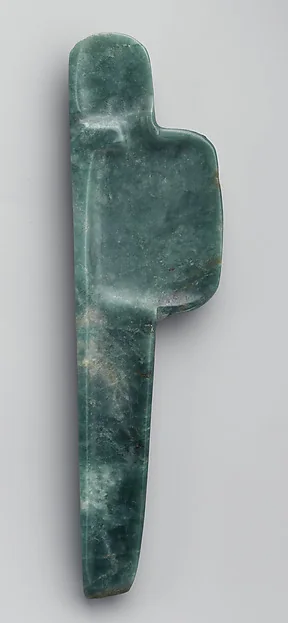
A weathered exterior or small window offers local evidence. Sawing reveals a larger interior surface and may confirm or overturn the first plan. GIA’s account of Burmese jade documents examination, sawing with diamond-coated equipment and water, and specialized production in the jade trade. The new face makes color, texture and fractures more visible, but still does not guarantee continuity through the remainder.
Orientation balances color placement, thickness, visible fractures and usable area. A large blank is not automatically the better outcome if its critical edge contains a fracture or its strongest color is misplaced. Yield should therefore be discussed as usable form, not retained weight alone.
Blanking assigns a future form
A slab may offer circles for bangles, smaller areas for cabochons or beads, and irregular volumes for carving. The chosen outline determines where later corrections remain possible. A bangle requires a broad continuous annulus; a cabochon concentrates one face; beads multiply the matching problem; carving can respond to contour and color boundaries.
These are not automatic ranks. The right form is the one the documented material can support coherently. Detailed form decisions appear in cabochon shaping and bangle making.
Grinding establishes geometry
After sawing, abrasive shaping removes saw marks and refines edges, domes, inner curves or relief. Coarser damage must be removed before a finer stage can produce a continuous finish. Skipping preparation can leave deep scratches beneath gloss or round an edge while chasing a local mark.
Check geometry before final polish. A reflected guide line can expose a flat spot on a dome, waviness on a broad plane or an abrupt transition around a bangle. Correcting these after finishing requires returning to material removal.
Polishing reveals preparation
GIA describes fine jadeite polish through smooth luster and sharp, undistorted reflections, without visible pitting or orange-peel texture. This is more exact than saying a piece is “very shiny.” Follow a straight reflection across the surface while rotating the object.
Different geometries demand different inspection. A cabochon carries reflection over an apex; a bead repeats highlights; a bangle asks for continuity around inner and outer curves; carved recesses may use a softer finish but should still read as deliberate. Dust and oil should be removed before assessment.
Color is reorganized, not created
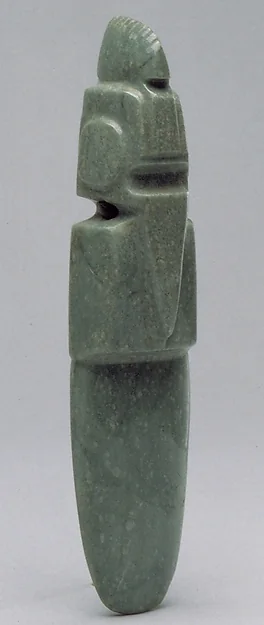
Cutting changes which color zone is presented; thickness and polish change how it is seen. Carving can integrate uneven color through qiaose, a practice documented by GIA. None of these processes proves that color is natural. Dye and other treatments remain laboratory questions.
Photographs amplify this distinction. Wet rough, strong transmitted light and polished surfaces can all increase apparent richness in different ways. Compare under controlled conditions and avoid predicting finished color from one rough image.
What the finished surface can disclose
A finished object can show whether outline, thickness, transitions and reflection are coherent. It cannot reveal the entire original rough, calculate exact material loss or map every hidden fracture. Nor can polish authenticate jadeite.
Use a staged inspection: face, profile, back, edges, reflected line and controlled transmitted light. Record what is visible and separate material identity, treatment and value. This approach turns workmanship into observable evidence without extending beyond it.
Research basis
- Burmese Jade: The Inscrutable Gem — Gems & Gemology, GIA
- Jadeite Quality Factors — GIA
- The Evolution of Chinese Jade Carving Craftsmanship — Gems & Gemology, GIA