A cabochon is shaped around light, not a standard diagram
A cabochon has no facets to divide its face into crisp flashes. Its outline, dome and polish carry the entire visual argument. In jadeite, that geometry also changes how color and translucency appear. The cutter therefore begins with a particular piece of material—not an ideal oval—and asks where the most coherent face, sufficient thickness and safest edge can meet.
GIA identifies symmetry, proportion and thickness as central considerations when buyers examine jadeite cabochons. It also notes that top material is not necessarily forced into calibrated dimensions, because preserving useful rough can matter more than matching a commercial size chart. This does not mean irregularity is automatically desirable. It means proportion should be judged in relation to the individual stone.
First choose the face
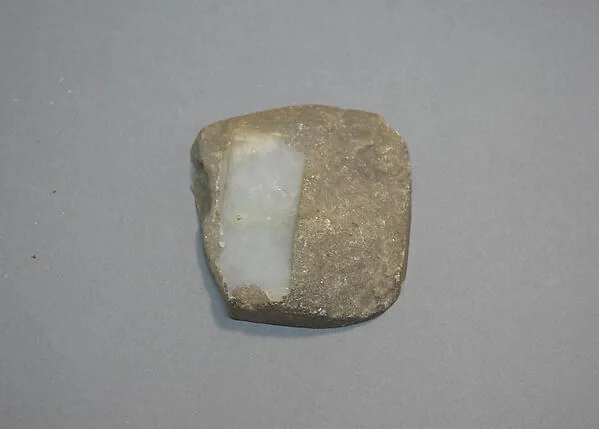
Orientation determines which color zone becomes the face and how much material supports it from behind. A strong patch near the surface may disappear if the blank is ground too deeply. A translucent area may appear brighter when thinned, yet lose color concentration. A visible fracture near the intended edge may require a smaller outline or a different orientation. These are tradeoffs, not rules that can be settled by one measurement.
The early stages belong to cutting and blank planning. A selected area is separated, then ground toward a workable outline. Because every correction removes material, the maker normally establishes the face and major axis before refining the dome. Photographs of rough cannot disclose the full depth of color or fractures; a promising surface remains a local sample.
Outline: regular enough to read, responsive enough to fit
Oval cabochons are common, but round, pear-shaped and other outlines also occur. A successful outline feels continuous: left and right sides answer one another, the shoulders turn without sudden flattening, and the long axis is deliberate. Symmetry is easiest to test from directly above, then again from the reverse. A tilted photograph can make one shoulder look fuller, so assessment should include a centered view.
Calibration matters when a stone must fit a premade mount. A custom setting can follow an individual outline more closely. GIA’s quality guidance makes the useful distinction that fine jadeite is often shaped to preserve rough rather than meet a standard calibrated size. The practical question is whether the outline looks resolved and can be supported safely—not whether it matches a mass-produced template.
Dome, apex and thickness
The dome organizes reflection and the apparent depth of color. A low dome can spread the face widely but may reduce the sense of volume. A high dome adds depth yet must remain balanced with the outline and setting. Viewed in profile, the rise should reach its apex intentionally rather than forming a flat plateau or leaning to one side.
Thickness includes the material below the visible dome. It affects color concentration, translucency and how the cabochon sits in a mount. GIA specifically includes thickness in cabochon assessment. More thickness is not automatically better: unnecessary depth can make a piece visually heavy, while an over-thin edge can constrain setting options. The relationship among face, edge and back matters more than a single number.
For a useful comparison, inspect the cabochon in face-up, profile and back views. Face-up shows outline and color placement; profile shows dome and edge; the back reveals whether the form is centered and how much body remains. A closed setting may later hide much of that evidence.
Polish completes the geometry
A dome cannot be judged apart from its finish. Under a diffuse rectangular light, a smooth cabochon should carry a continuous reflection across the curve. A sudden wobble can disclose a flat spot or uneven transition. GIA describes fine jadeite polish through sharp, undistorted reflections and the absence of visible pitting or orange-peel texture. Learn the inspection method in the jadeite polishing guide.
Dust, oil and image sharpening can mislead. Clean conservatively before deciding that a surface needs work, and do not treat a bright product photograph as proof of fine polish. Repolishing removes material and can change dome proportion or soften the edge; it is a professional intervention, not routine care.
How the setting changes the reading
A prong setting leaves more edge visible but applies localized contact; a bezel surrounds the girdle with metal and can visually tighten the outline. Neither style is universally superior. The choice depends on the individual cabochon, the condition of its edge, the intended wear and the setter’s skill. Our guides to prong settings and bezel settings examine those tradeoffs.
Before a mount is accepted, check that the cabochon sits level, that contact points are deliberate and that metal does not conceal a chip presented as mere design. After setting, inspect the stone from several angles. A beautiful face is only one part of a well-resolved cabochon.
Research basis
- Jadeite Quality Factors — GIA
- Burmese Jade: The Inscrutable Gem — Gems & Gemology, GIA
- Gemstone Durability: Design to Display — Gems & Gemology, GIA