Beads and cabochons solve opposite design problems
A cabochon concentrates attention on one face. A bead repeats a form and must relate to its neighbors. Both are polished jadeite shapes, yet the questions a viewer should ask are different. For a cabochon, outline, dome, thickness, orientation and face-up color placement dominate. For beads, consistency of size and shape, drill alignment, color sequence, texture, transparency and surface finish build the strand.
GIA names symmetry, proportion and thickness when discussing jadeite cabochons. For bead matching it gives greatest weight to color and texture, with transparency, size and symmetry of cut also considered. Those criteria are a useful starting point, not a single grading formula.
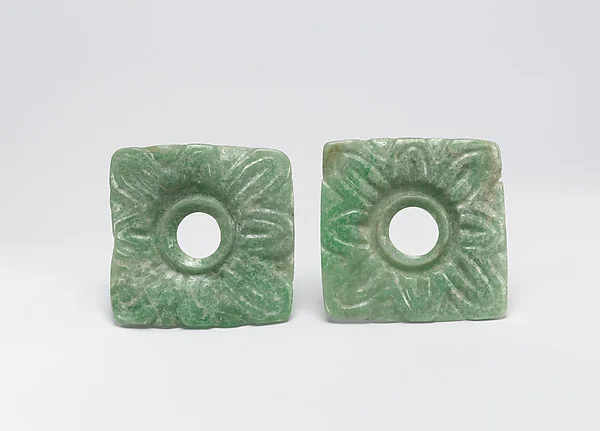
Cabochon: choose the face before the outline
Color and translucency occupy three-dimensional material. Turning a blank changes which area faces the viewer and how much thickness remains behind it. A strong color patch can be centered, allowed to drift deliberately, or lost through excessive grinding. The outline follows that first orientation decision.
Viewed from above, check whether the shoulders and long axis feel resolved. In profile, follow the dome to its apex and compare both sides. The back reveals remaining thickness and whether the form is centered. Fine jadeite is not always forced into calibrated dimensions; GIA notes that preserving valuable rough can take precedence. The deeper process is covered in jadeite cabochon shaping.
Bead: repeat shape without erasing material
Equal diameter alone does not make a matched strand. Slight ovality, flattened poles or an off-axis hole changes how a bead sits. Test a short sequence on cord and let it hang naturally. A kink may come from the drill path rather than the color or outer diameter.
Color matching should compare hue, tone, saturation and distribution under the same light. Perfect sameness is not the only coherent arrangement: graduation around a center can be deliberate. What matters is whether differences form a readable sequence. See jadeite bead matching for a full inspection order.
Light behaves differently in a dome and a sphere
A cabochon offers a broad face and a curved profile. A bead presents every orientation as it turns. Both appear more translucent near thin edges than through thicker centers, so compare equivalent paths rather than declaring one area “better.” Color, thickness and surface reflection can reinforce or counter one another.
Use diffuse neutral illumination first, then a restrained transmitted light where useful. Rotate the object instead of moving it between unrelated light sources. Photography can flatten mottling, brighten dark beads and hide a cabochon’s flat spot. The controlled method in jadeite under different lighting helps separate material from setup.
Polish is a shared criterion
GIA associates fine jadeite polish with sharp, undistorted reflections and no visible pitting or orange-peel texture. On a cabochon, follow a straight reflection across the dome. On beads, compare the clarity and movement of highlights from one unit to the next, including the area around each drill opening.
Brightness alone is weak evidence. Oil, dust, image sharpening and a large soft light can change the impression. Clean conservatively and inspect in motion. Surface finish is explored in the polishing guide.
Setting and stringing create different risks
A mounted cabochon contacts metal at a seat, prongs or bezel. Fit, pressure and edge condition matter. A bead strand concentrates wear at holes, cord and neighboring beads; drill chips and rough hole edges deserve attention. Neither finished form can prove identity or treatment.
Inspect a cabochon before metal hides its edge and back. Inspect beads both loose and strung, because alignment problems may appear only under tension. For material identity and treatment, rely on appropriate gemological evidence rather than symmetry, sound or coolness.
A side-by-side viewing sheet
| Question | Cabochon | Bead or strand |
|---|---|---|
| Primary geometry | Outline, dome, apex, thickness | Diameter, roundness, sequence |
| Orientation | Face-up color placement | Color around each rotating bead |
| Connection | Seat and setting contact | Hole axis, cord and neighboring beads |
| Finish | Reflection across dome and edge | Consistent reflection and finished drill openings |
Record observations before assigning adjectives. This makes comparison repeatable and keeps form quality separate from authenticity claims.
Condition changes with the form
A small chip at a cabochon girdle may lie beneath a mounting or directly under a prong; its significance depends on location and contact. On a bead, chips around the hole can interact with cord movement, while a surface-reaching line may become visible only as the bead rotates. Describe location before deciding severity.
For a strand, inspect units individually and then under natural hanging tension. Clasps, knots and cord condition belong to the object even though they are not jadeite. For a mounted cabochon, inspect the metal seat and reverse where accessible. Condition is not a proxy for treatment: a pristine object may be treated, and an untreated object may show wear.
Which form suits which observation?
A cabochon gives one concentrated view of color and dome, useful when a particular face is the point. Beads create repetition and motion, revealing how material changes across a group. Neither form is inherently a higher expression of jadeite. The more exact judgment asks whether the chosen form makes the material intelligible and whether workmanship resolves the constraints it creates.
Research basis
- Jadeite Quality Factors — GIA
- Burmese Jade: The Inscrutable Gem — Gems & Gemology, GIA
- Gemstone Durability: Design to Display — Gems & Gemology, GIA