Color is four observations, not one name
Calling jadeite “green” records too little. GIA assesses colored gemstones through hue, tone and saturation, and treats distribution as a further concern in jadeite. Hue names the color family; tone describes relative lightness or darkness; saturation describes strength; distribution follows where color gathers, thins or changes.
Write these observations before assigning a trade adjective. “Medium-dark green concentrated on one side, becoming paler at the edge” can be checked by another viewer. A label such as “imperial” carries market expectations and should not replace measured description or laboratory evidence.
Hue: name what is actually present
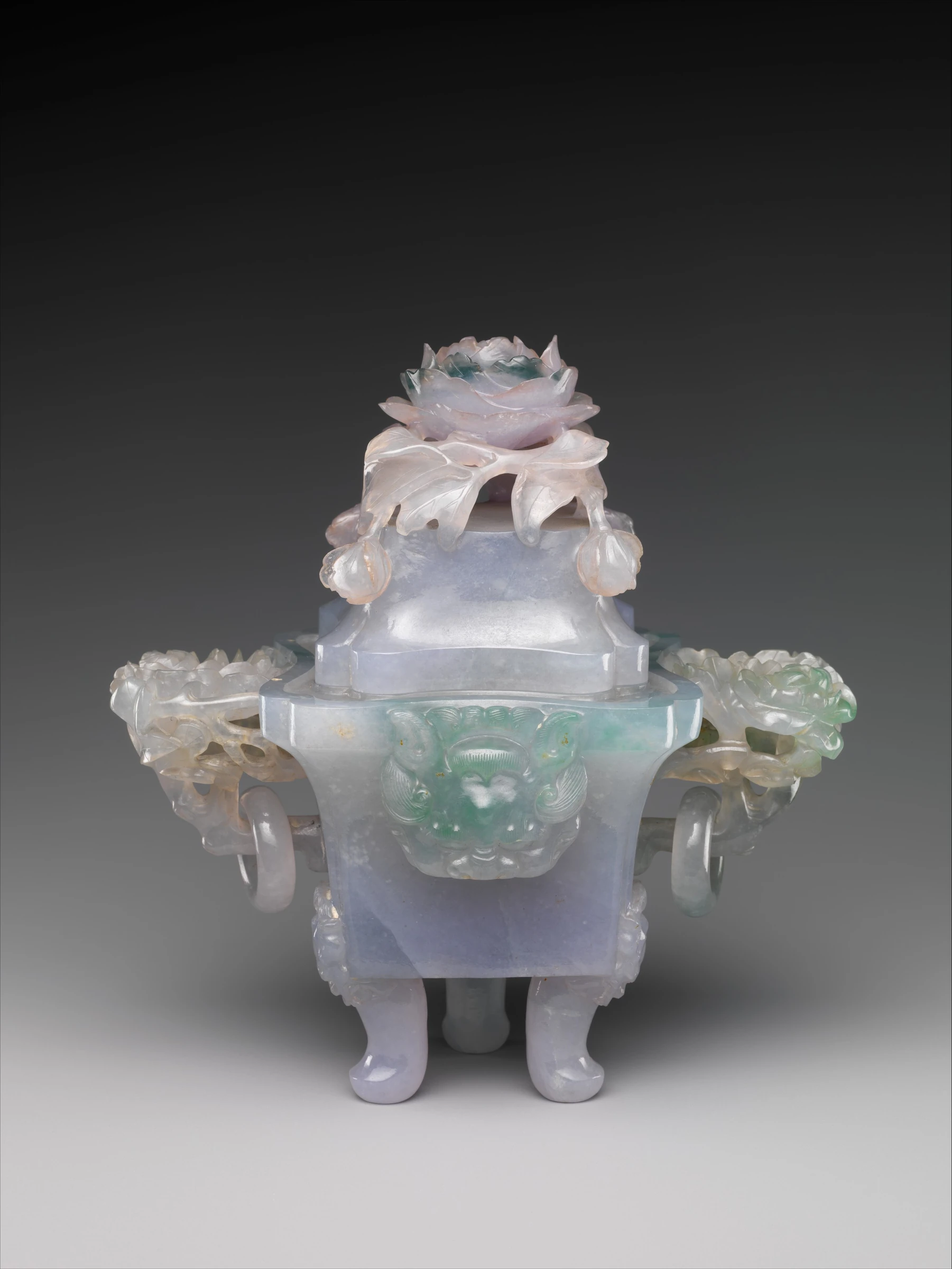
Jadeite occurs in green as well as lavender, red, orange, yellow, brown, white, black and gray, according to GIA. A single object can contain more than one hue. Describe the dominant hue and any secondary zones without forcing them into one word.
Reflected surroundings matter. Warm walls can make pale material look yellower; green fabric can cast color into a polished surface. Use a neutral background and compare the object away from strongly colored clothing. The purpose is not to make it look less beautiful, but to discover which color belongs to the jadeite.
Tone and saturation: darkness is not strength
A color can be dark yet weak, or lighter yet vivid. Tone and saturation therefore need separate language. Very dark tone may obscure texture and transparency, while very light tone can make a hue appear delicate. Neither observation alone determines quality.
Exposure controls can confuse them in photographs. Increasing exposure lightens tone; boosting color or contrast can exaggerate saturation. Ask for a neutral reference and more than one lighting condition. Avoid comparing two images processed by different cameras as though they were laboratory color measurements.
Distribution: follow color through the form
Color may be even, mottled, veined, spotted or concentrated in a limited area. GIA identifies evenness as important in some fine jadeite, but form changes the question. A cabochon asks where color sits face-up; a bangle reveals a continuous transition; a carving may use a natural boundary as part of its design.
Rotate the object. A surface patch may continue around an edge or vanish within a shallow depth. Thickness also changes apparent concentration. The craft implications appear in jadeite cutting and jadeite carving.
Lighting changes the answer
GIA notes that jadeite can appear different under fluorescent and incandescent light. Daylight also changes with time, weather and reflected surroundings. Record the source, use diffuse illumination and compare under a second controlled source. A difference between lamps is not itself evidence of dye or authenticity.
Backlighting can make thin edges glow and can exaggerate the visual reach of a color zone. Use it to study distribution and translucency, then return to reflected light for ordinary appearance. The full protocol is in how lighting changes jadeite.
Color, transparency and texture interact
Transparent or translucent material lets light travel beneath the surface, changing the sense of depth. Fine texture can make color appear more unified; coarser structure may break it into visible granular variation. Thickness and polish add further effects. These interactions are why a color chart cannot represent an entire object.
Keep the categories separate in notes: color description, transparency at a stated area, apparent texture, thickness and surface finish. Our guide to transparency and texture explains how to compare equivalent regions.
Color cannot diagnose treatment
Dye can alter jadeite color, but an even, bright or concentrated appearance is not by itself proof of dye. Natural jadeite can be vivid or uneven, and treated material can be subtle. Polymer impregnation and dye identification require suitable gemological methods.
Do not rely on “color roots,” coolness, phone filters or a single loupe photograph as a verdict. If treatment matters, use a laboratory report and read its exact wording. Continue with natural versus treated jadeite.
A repeatable color record
Photograph face, profile and back against neutral gray under a documented light source. Include a scale, avoid automatic beauty filters and do not wet the surface. In writing, record hue, tone, saturation, distribution, the area observed, thickness where known and any change under the second light.
This record is not an appraisal. It allows later comparison without claiming that color alone determines identity, treatment, origin or price. Precise observation is more durable than an enthusiastic label.
Research basis
- Jadeite Quality Factors — GIA
- Jade Description — GIA