Rough jadeite offers clues, not promises
A rough boulder may show weathered skin, an opened window, a sawn face or several generations of working. Each surface provides a different sample. None reveals the whole interior. Responsible observation records what a surface shows and what remains hidden.
GIA’s field account of Burmese jade documents how traders and cutters examine rough, open windows and make progressively larger cuts. Knowledge changes as the stone is opened. This is why a photograph cannot support guaranteed yield, color continuity or a fixed finished grade.
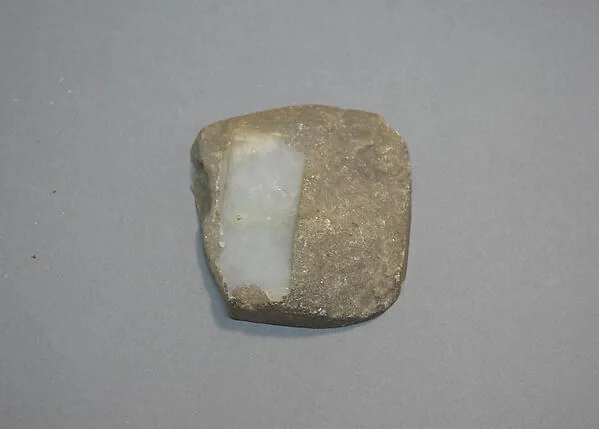
Skin is an altered exterior
The outer surface records weathering and handling rather than presenting a polished interior. Texture, staining and attached material can obscure the jadeite beneath. A surface color should not be assumed to continue inward, and a smooth patch may be a worked area rather than natural skin.
Describe skin neutrally: color, roughness, adhering material, fractures and any ground or cut areas. Folk names for skin patterns vary across markets and should not be converted into scientific predictions.
A window is a local sample
A window removes a small part of the exterior to expose material beneath. It can show local color, texture, transparency and visible features. Its main limitation is scale: the observed area may be selected precisely because it looks promising.
Note window dimensions, depth, whether it is wet, the lighting direction and where it sits on the boulder. Compare its edges for changes. The wider caution appears in why rough cannot be judged from photos alone.
A sawn face reveals more—and creates new uncertainty
A cut face shows a larger section through the material. Color zones, aggregate texture and fractures may become clearer. Yet it is still one plane. Features can change immediately beyond it, and saw marks, water or oil can alter visual impression.
Photograph a cut face dry under diffuse light, then add a controlled wet view only as supplementary evidence. Label both. Wetting lowers surface scatter and can make color seem richer; it does not transform the material.
Color is three-dimensional
GIA describes jadeite color through hue, tone, saturation and distribution. On rough, distribution must be imagined cautiously through depth. A green line on a face may be a thin vein, broad zone or surface-limited feature. Only additional cutting reveals more.
Orientation trades color placement against thickness, fractures and usable area. The process is explained in how jadeite is cut. No responsible viewer can calculate finished color from one selected window.
Texture, fractures and inclusions
Texture describes the apparent fineness of the aggregate. A cut face can offer better evidence than weathered skin, but polish and transmitted light will change how the finished material appears. Fractures should be mapped by location and direction without assuming they stop where they disappear.
Internal features are not interchangeable. Cloudy zones, granular variation, color concentrations and fractures require different words. GIA notes that fractures affect appearance and durability; photographs may not reveal depth or continuity.
What a rough photograph should include
| View | Why it matters |
|---|---|
| All sides, dry | Overall shape, skin and worked areas |
| Window close-up | Local sample and its boundaries |
| Cut face, neutral light | Color, texture and visible lines on one plane |
| Scale and weight record | Physical context, not yield prediction |
Include exposure and white-balance information when possible. A dramatic backlit or wet image can supplement, never replace, the dry neutral record.
Identity and treatment remain laboratory questions
Rough appearance does not guarantee jadeite, geographic origin or untreated status. Visual clues can guide questions, not deliver a conclusive home test. If the claim matters, use appropriate analysis and read the report’s scope.
A laboratory report also does not promise what finished forms a boulder will yield. Gemological identity and cutting prediction are different tasks. The finished-object side of this distinction appears in how to evaluate jadeite.
Research basis
- Burmese Jade: The Inscrutable Gem — Gems & Gemology, GIA
- Jadeite Quality Factors — GIA