The frame is selective
A lens shows one angle, one exposure and one moment of surface preparation. Wetting can deepen apparent color; directional light can make a thin edge seem more translucent. Compression may erase fine fractures.
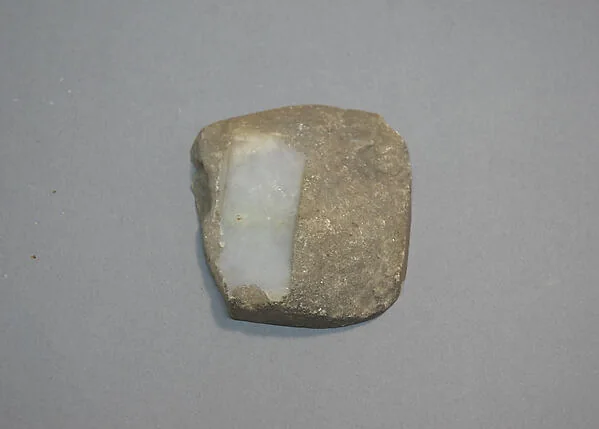
What remains hidden
A window may miss internal cracks, pale zones, coarse areas or changes in color direction. Even a cut face is only a plane through a three-dimensional material. Claims of certainty from a handful of images exceed the evidence.
A disciplined remote review
Request dry and wet views, neutral light, video rotation without beauty filters, dimensions, weight if relevant and close-ups of every exposed face. Treat the result as preliminary observation, never a promise of outcome.
Control the photograph before comparing
Ask whether the surface is wet, whether light is transmitted from behind, and whether exposure or saturation has been changed. Place a neutral reference and scale beside the material. These controls improve description; they do not remove the uncertainty inside rough.
A photograph is a record of one exposed surface
Rough jadeite is three-dimensional; an image collapses it into one framed view. Skin hides material, a window samples a small locality, and a sawn face reveals only one plane. None establishes how color, fractures or texture continue through the volume.
Begin with the surface vocabulary in rough jadeite basics. The useful question is not “What will this become?” but “What evidence is visible here, under what conditions?”
Wetting and backlighting change the evidence
Water reduces surface scattering and can deepen apparent color on a rough face. Strong transmitted light makes thin edges and openings glow. Both views can reveal something, but neither should replace a dry, diffuse-light record. Label each condition.
Exposure, saturation, sharpening and noise reduction can remove weak boundaries or intensify green. Request an unedited sequence with fixed exposure and a neutral reference. The broader optical controls are described in how lighting changes jadeite.
A minimum remote-view protocol
| Record | What it supports | What it cannot prove |
|---|---|---|
| Six dry sides | Shape, skin, visible fractures | Hidden continuity |
| Window and boundary | One local sample | Whole-boulder color |
| Dry and wet cut face | Surface comparison | Finished yield |
| Scale, dimensions, weight | Physical context | Quality or treatment |
Add a slow rotation with no beauty filter. Inspect every pause rather than relying on a single selected frame.
What remains unknowable
A fracture may change direction beyond the surface. A color zone may narrow, widen or stop. Texture may vary across geological domains. Cutting creates new evidence, but also removes material; the process is a sequence of decisions under uncertainty, not a guaranteed reveal.
That decision chain is covered in jadeite cutting. Remote observation should never be converted into promises of yield, finished grade or financial outcome.
Identity is a separate question
Images cannot conclusively establish jadeite species, treatment or geographic origin. A laboratory may analyze a submitted sample or object, but its conclusion applies to the item examined and does not map an unopened boulder’s entire hidden volume.
Keep three records apart: photographic description, gemological identification and cutting estimate. Combining them into one confident claim is where most overstatement begins.
Research basis
- Jade Description — GIA
- Jadeite Quality Factors — GIA
- The Met Open Access — The Metropolitan Museum of Art