Evaluation is a sequence of observations
Jadeite cannot be reduced responsibly to one adjective or a single “grade.” Appearance emerges from color, transparency, texture, polish, form, size and condition, while identity and treatment belong to gemological examination. A useful evaluation keeps those questions separate, then asks how the visible qualities work together.
Begin in neutral, diffuse light with a clean surface. Record what is actually visible before using trade language: the hue, how light or dark it appears, how concentrated the color is, where it gathers, how far light enters, whether the structure looks fine or coarse, and how reflections travel across the finish. GIA treats these as related quality factors rather than a universal scoring formula.
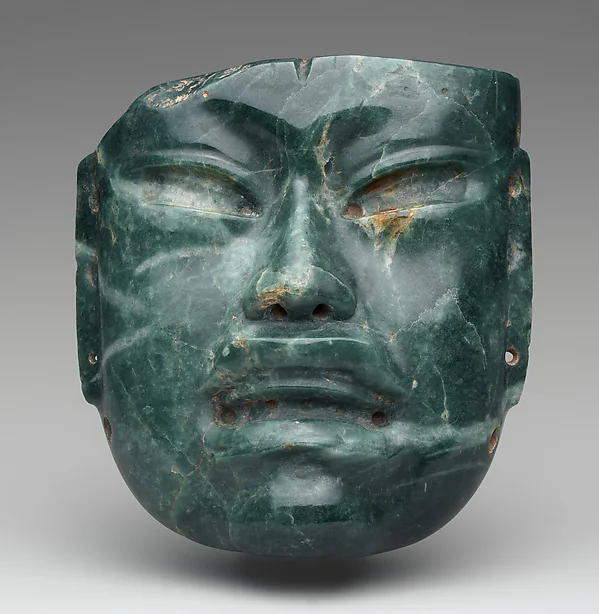
Step one: establish what the object is
“Jade” is an umbrella trade and cultural term most often applied to jadeite and nephrite, two different materials. Visual resemblance is not enough to distinguish them in every case, and look-alikes also exist. If identity matters to a purchase or collection record, begin with a report from an appropriate gemological laboratory rather than a home test.
A report should be read for its exact material identification and treatment wording, not merely for the presence of a logo or the word “natural.” Our guides to jadeite versus nephrite and reading a jadeite report set out that boundary. Evaluation of beauty does not replace identification.
Step two: read color as four questions
GIA describes jadeite color through hue, tone, saturation and distribution. Hue names the color family. Tone asks how light or dark it appears. Saturation describes strength rather than brightness alone. Distribution follows where color is even, mottled, concentrated or transitional.
Do not inspect color under one dramatic lamp. GIA notes that jadeite can look different under fluorescent and incandescent illumination. Compare under diffuse daylight or a stable neutral source, then under the light in which the object will normally be worn. A shift is an observation about illumination, not evidence of authenticity or treatment. See how to read jadeite color.
Evenness is not automatically superior to every patterned distribution. A carving may use a color boundary deliberately; a bead strand may require coherence across multiple units; a plain cabochon places greater pressure on the face-up arrangement. Judge distribution in relation to form.
Step three: separate transparency from texture
Transparency concerns how light enters and travels through the material. Texture describes the visual fineness or coarseness created by the aggregate structure. Fine texture can support a smooth, unified appearance, while coarser texture may become evident in transmitted or grazing light. Thickness, curvature, color and lighting all influence the observation.
Compare equivalent areas. A cabochon edge has a shorter light path than its center; a bangle varies around its circumference; a carved recess may be thinner than the surrounding relief. Calling one edge “more transparent” without accounting for geometry can mislead. The detailed guide to transparency and texture provides a controlled method.
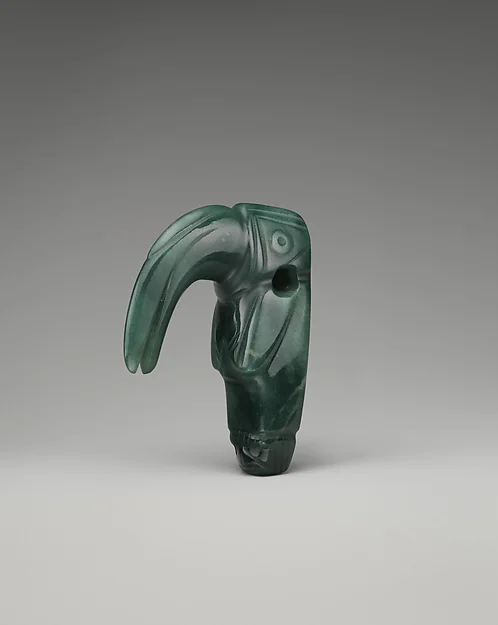
Step four: let workmanship explain the material
Cutting determines orientation and retained thickness. A cabochon should be read through outline, symmetry, proportion and dome. Carving should show purposeful transitions rather than detail for its own sake. GIA associates fine polish with smooth luster and sharp, undistorted reflections, without visible pitting or orange-peel texture.
Rotate the piece under a straight reflected light. A continuous reflection discloses smooth geometry more reliably than a bright front photograph. Inspect back and edges as well as the presentation face. A setting can hide part of the edge, alter the visual boundary and complicate cleaning; it should be assessed as structure, not decoration alone.
Step five: describe condition precisely
Fractures, chips, pits, scratches, repairs and ordinary internal features should not be collapsed into one word such as “flaw.” Record location, direction, whether a feature reaches the surface and how it relates to a critical edge. GIA notes that fractures can affect appearance and durability, but a photograph may not reveal their depth or continuity.
Condition is distinct from treatment. A natural fracture does not prove that material is untreated, and a fine polish does not prove that it is. Treatment terminology requires laboratory methods, especially for polymer impregnation or dye. Use natural versus treated jadeite for that question.
Step six: compare like with like
Evaluation becomes clearer when comparable forms are viewed under the same conditions. Compare cabochons of similar dimensions, bangles of related profile, or beads at equivalent positions in a strand. Do not use price as a shortcut for observation, and do not convert a laboratory identity report into an appraisal.
Write a short record: light source, dimensions, form, color distribution, transparency at specified areas, texture, polish, visible condition and report wording. This disciplined description is more useful than a compressed letter grade because another viewer can repeat it. Value and preference still require context beyond the scope of this educational guide.
A viewing protocol that can be repeated
Place the object on a neutral, non-reflective surface. Begin with diffuse illumination, then add a controlled transmitted light only where thickness permits. Observe face, profile, back and edges in the same order. Clean fingerprints before comparing polish, and allow the piece to dry before recording color. Note the light source rather than writing “natural light,” which can vary strongly by time, weather and nearby surfaces.
Use description before judgment. “A medium-dark green area occupies one side and becomes paler toward the opposite edge” can be checked by another viewer. “Excellent color” cannot. Likewise, “a surface-reaching line crosses the inner wall at one point” is more useful than “minor flaw.” Precision does not make an observation harsh; it makes it honest.
When comparing several objects, change one variable at a time. Keep light and background stable, place similar forms at the same angle, and avoid holding one piece directly over a phone torch while another sits in room light. The aim is not to manufacture a ranking. It is to discover which difference belongs to the material and which belongs to the viewing setup.
Common shortcuts and why they fail
Weight, coolness, sound and color concentration are frequently presented as home authentication tests. Each can vary for reasons unrelated to identity, and tapping introduces needless risk. A vivid green area does not prove untreated jadeite; a muted object is not thereby false. Surface luster can reflect polishing, coating, residue or photography.
Another shortcut is to treat every internal line as a crack or every cloudy area as poor texture. Use neutral language until its nature is established. Magnification may improve description, but it still does not replace analytical methods for treatment. The better outcome is a clear list of what is known, what is observed and what remains unresolved.
Research basis
- Jadeite Quality Factors — GIA
- Jade Description — GIA
- Burmese Jade: The Inscrutable Gem — Gems & Gemology, GIA