Jadeite entered an older jade culture
Chinese jade history is much longer than Chinese jadeite history. “Jade” in early ritual and court objects often refers to nephrite or other materials identified by scholarship, not automatically to jadeite. GIA’s history of Chinese jade carving places the emergence of jadeite carving in the Qing dynasty. That later arrival matters: jadeite joined an established language of material, craft and symbolism rather than originating it.
The distinction protects both histories. Ancient nephrite should not be relabeled jadeite for convenience, and Qing or later jadeite should not be treated as culturally shallow because it is newer. Material identification and cultural importance answer different questions.
Why chronology is easily blurred
English and Chinese both use broad jade terms in ordinary speech. Museum catalogs, laboratory reports and historical studies may distinguish nephrite, jadeite or another material more precisely. A modern caption that says only “jade” cannot support a scientific jadeite claim without additional evidence.
Start with the source’s material term and date. If a museum says jadeite, retain it; if it says jade or nephrite, do not upgrade the label. The material distinction is explained in jadeite versus nephrite.
Qing jadeite and changing craft
GIA’s carving history identifies jadeite carving as emerging in the Qing period, while the broader craft sequence includes much earlier cutting, grinding, drilling, polishing, relief and openwork in jade. Jadeite makers inherited established techniques but responded to a material with its own color range and aggregate structure.
Color offered new compositional possibilities. The practice known as qiaose—using naturally uneven color artistically—predates jadeite and could be applied to later jadeite carvings. Cultural continuity lies in the method of looking at material, not in claiming every earlier object was made of jadeite.
Vessel forms, jewelry and the scholar’s object
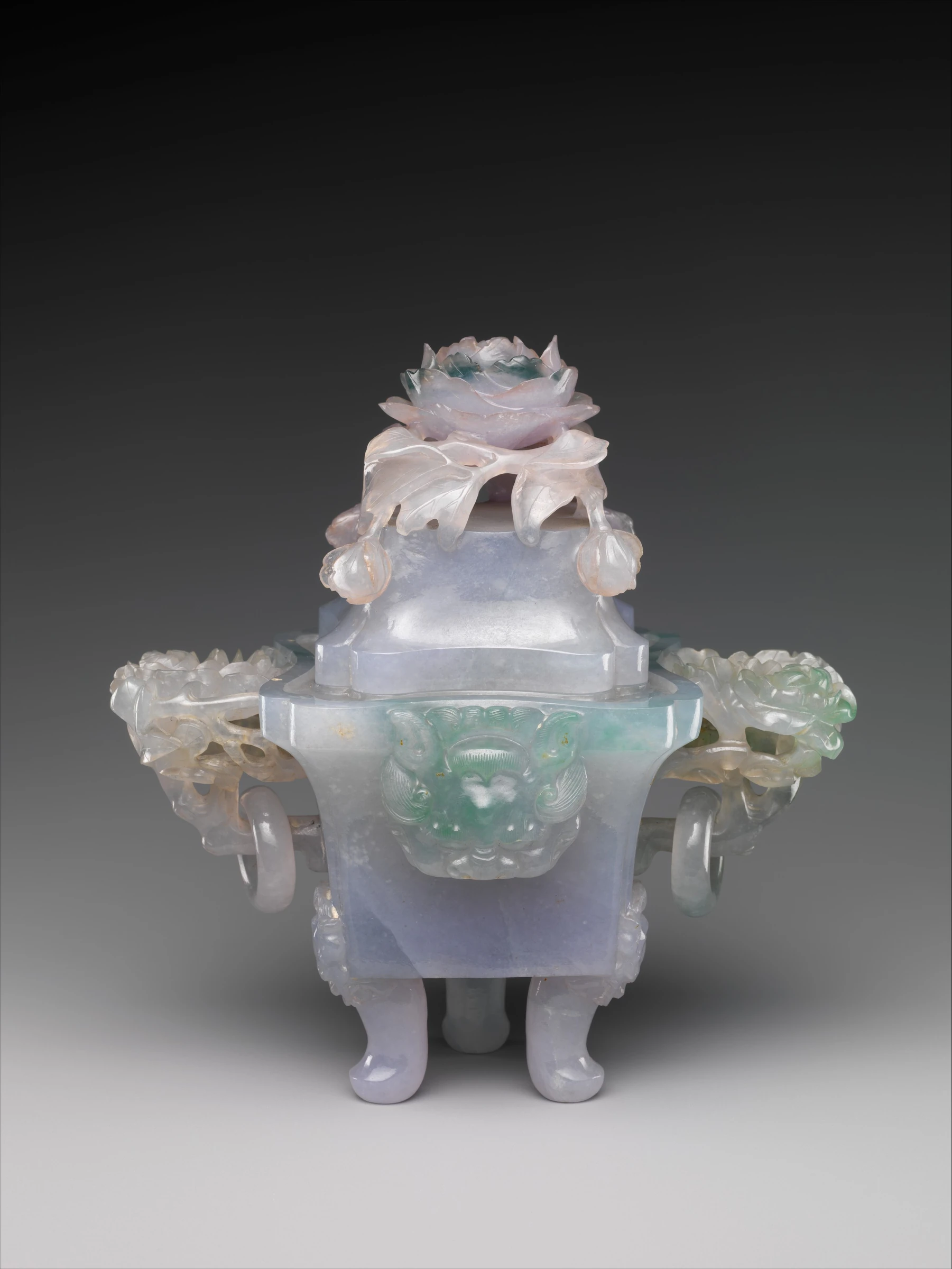
Jadeite appears in personal ornaments, jewelry, vessels and decorative objects. The museum tripod shown here adopts an archaic vessel silhouette in a later material. Such references can connect a Qing or later object with older visual traditions without making it ancient.
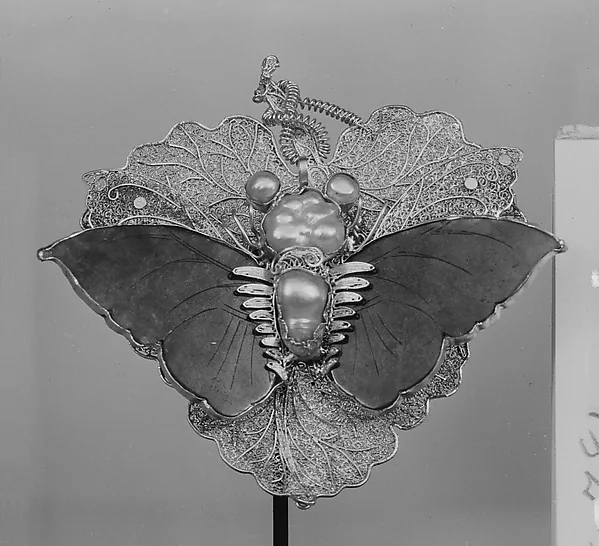
Jewelry changes the scale of encounter. A cabochon, pendant or bangle brings color and polished surface close to the body. Its cultural meaning can arise through gifting, family use or contemporary taste, but those individual histories should be documented rather than generalized into a universal tradition.
Symbols need dates and contexts
Ruyi, gourds, bamboo, leaves, animals and circular forms are often given auspicious readings today. Some associations have historical documentation; others are modern conventions or vary by region and audience. A responsible account states which kind of evidence supports each claim.
GIA’s craft history provides a useful model in its discussion of a late-Shang jade turtle: the object, archaeological context and longevity association are bounded together. That evidence should not be expanded to every turtle carving across time. The method is developed in reading jadeite carving and motifs.
Modern meaning can be real without being ancient
A family may understand a bangle as continuity; a pendant may mark a gift or personal memory; a contemporary maker may use a traditional silhouette in a new way. These meanings are culturally real when attributed accurately. They do not need an invented ancient origin to matter.
Use language such as “commonly read today,” “in this documented family context,” or “the maker states.” Avoid saying a motif always guarantees luck, health or protection. Symbolic interpretation is not a physical property of jadeite and should never become a medical or investment promise.
Museums and provenance discipline
Museum records help separate object name, material, date, culture and acquisition history. They are strong anchors, though attributions may change as scholarship develops. Cite the current record and access date, and avoid extending a catalog statement beyond its scope.
For privately held objects, record known provenance and distinguish it from family tradition or seller narrative. Laboratory reports can address material and treatment, not cultural intention. Photographs can document form, not prove age. Each evidence type has a proper task.
A quieter way to write about culture
Begin with the object: what material is documented, how it is made, what form it takes and where the source places it. Add historical context where sources support it. Let modern interpretation appear in its own voice rather than masquerading as archaeology.
This approach preserves poetry without sacrificing truth. Jadeite’s color, translucency and polished surface can carry memory and symbolism; careful chronology lets those meanings breathe instead of trapping them in a slogan.
Research basis
- The Evolution of Chinese Jade Carving Craftsmanship — Gems & Gemology, GIA
- Chinese Jades in the Freer Gallery of Art — Smithsonian Institution
- Jadeite Tripod Incense Burner — The Metropolitan Museum of Art