Read the object before assigning a meaning
A carved subject has at least three layers: the material object, the historical context in which a motif appears, and the interpretation attached to it by a later viewer. These layers often overlap, but they are not interchangeable. A leaf-shaped pendant can be described as a leaf from its form; its date, regional meaning and intended blessing require evidence.
Begin with what is visible: outline, relief, drilled openings, inscriptions, color placement and wear. Then consult a museum catalog, excavation record or dated scholarly source. Modern retail symbolism may be culturally meaningful, but it should be labeled as a contemporary reading rather than projected unchanged into every historical period.
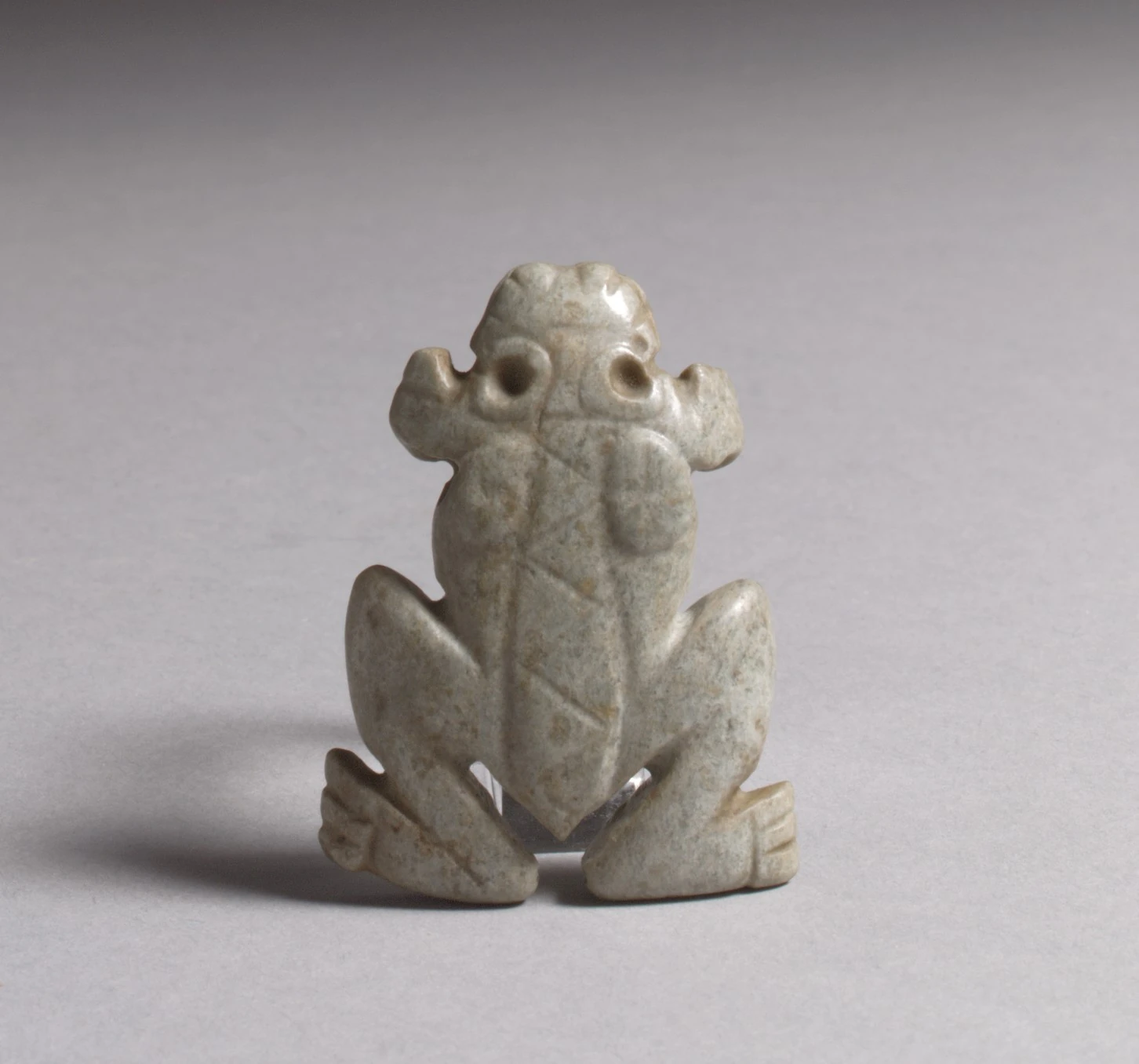
Jade history is longer than jadeite’s Chinese chapter
Chinese jade culture extends far earlier than the large-scale use of jadeite. GIA’s review of Chinese jade carving places the emergence of jadeite carving in the Qing dynasty, within a much longer history dominated by other jade materials, especially nephrite. A symbol documented on ancient nephrite should not automatically be relabeled as ancient jadeite history.
This distinction does not make later jadeite objects culturally lesser. It makes chronology clearer. Read jadeite in Chinese culture for the material timeline before using “ancient” as a broad marketing adjective.
Motif identification begins with form
A ruyi head, gourd, bamboo segment, leaf, animal or circular disk should first be identified by recognizable formal features. Similar curves can support different subjects; a worn or highly abstract carving may not permit certainty. Record the tentative identification and the evidence used.
Inscriptions, associated objects and catalog history can refine interpretation. Without them, a title supplied by a seller is not independent proof. Museum records are especially useful because they separate material, object name, date and culture, though older catalog attributions can also be revised.
Historical evidence and modern symbolism
Some motifs have documented associations in specific contexts. GIA’s carving history describes a late-Shang jade turtle using qiaose and notes the turtle’s longevity association in ancient Chinese burial use. That is a bounded claim: it concerns a documented object, period and context. It does not prove that every later turtle carving had one fixed intention.
Modern jadeite jewelry frequently uses auspicious readings for gourds, ruyi, leaves and animals. Such readings may guide gifting and personal attachment. Write them as “often read today as” or “commonly associated in contemporary jewelry,” unless a historical source establishes more. This language preserves cultural texture without turning interpretation into timeless fact.
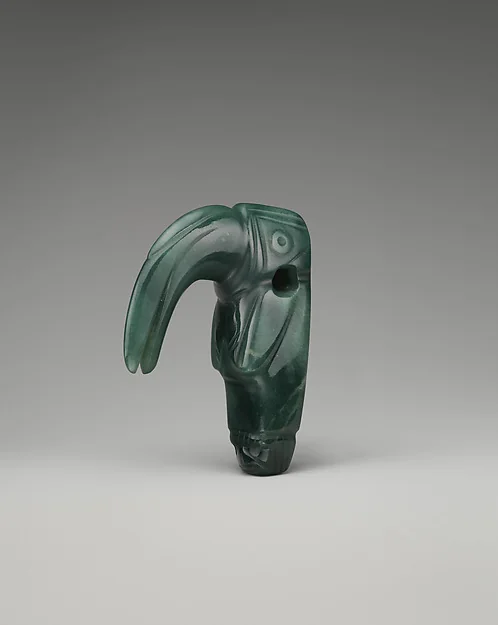
Color can participate in the design
GIA defines qiaose as taking artistic advantage of naturally uneven color. A dark area might become a shell, garment or leaf edge while a pale field carries another form. The practice links motif planning to the material rather than treating color as paint applied after carving.
Successful color use should be judged through the actual composition. Does the boundary clarify the subject? Does it continue around the form? Is an abrupt patch integrated or merely given a convenient story? The craft discussion in jadeite carving explains the decisions behind relief, contour and finish.
Technique is evidence too
Relief, piercing, chain carving, calligraphic engraving and inlay belong to different technical traditions. GIA’s review records these methods across periods and notes that modern practice includes manual carving, CNC engraving and three-dimensional replication. Tool choice alone does not date an object, but technique can narrow the questions a specialist asks.
Look at transitions rather than counting detail. Crisp lettering requires different control from rounded relief; openwork must resolve internal edges; a polished plain field may be as deliberate as a dense pattern. Workmanship and symbolism are related, but one cannot substitute for the other.
A responsible motif record
For each object, record material as documented, object type, dimensions, visible subject, inscription if any, stated date and culture, provenance source and the level of certainty. Add modern interpretation in a separate field. This prevents a poetic caption from silently becoming historical evidence.
Photographs should include back and side views when carving continues beyond the face. A single angle can make an abstract contour look like a familiar symbol. If identity, treatment or date matters commercially, use appropriate laboratory and scholarly evidence; motif recognition cannot supply them.
How to write a careful caption
A strong caption separates certainty levels. Start with the museum or laboratory material term, then object type, attributed culture or date, and source. Follow with a visible observation: “the dark zone forms the shell” is supportable when the object and source show it. Place interpretation last and qualify it where necessary.
Avoid converting a translated title into proof of original intention. Museum names can be descriptive conventions, and contemporary auspicious names may belong to current commerce. If several readings exist, state that plurality instead of choosing the most marketable one.
Motif, condition and recarving
Wear, repair or later carving can alter a motif. Softened edges may erase attributes needed for identification; a drilled hole can change how an object was worn; later inscriptions can add another historical layer. These questions require close object study and provenance. A visually plausible story is not enough.
Research basis
- The Evolution of Chinese Jade Carving Craftsmanship — Gems & Gemology, GIA
- Chinese Jades in the Freer Gallery of Art — Smithsonian Institution
- Ornament with Maya Glyph — The Metropolitan Museum of Art